Most unit planning starts with a question that feels productive but is actually fatal: "What activities should we do?" Wiggins and McTighe named the resulting failure modes the "twin sins" of design — activity-oriented and coverage-oriented curriculum. The engaging-but-aimless unit, and the march-through-the-textbook unit. Their alternative, Understanding by Design (UbD), is the most widely adopted curriculum framework in the world for one reason: it starts where the learning should end.
Stage 1: Identify Desired Results
Before choosing a single activity, answer three questions in order: What should students know? What should they be able to do? What should they understand — the enduring big ideas that survive after the details fade? Wiggins and McTighe use a three-layer filter: content that is worth being familiar with, content that is important to know, and the small core of enduring understandings. The discipline is in the subtraction: a unit cannot pursue everything, and as the UIC teaching guide notes, the point is prioritization, not coverage.
Stage 2: Determine Acceptable Evidence
This is the stage that makes the design "backward" — and the one teams skip most often. Before planning lessons, decide what evidence would show students actually achieved Stage 1. Not just a test: performance tasks, transfer situations, student work samples. UbD's "six facets of understanding" (explain, interpret, apply, have perspective, empathize, self-assess) give you a vocabulary for writing assessments that measure understanding rather than recall. If your Stage 2 evidence is a multiple-choice quiz, your unit — no matter how engaging — was designed for recall.
Wiggins and McTighe's sharpest line: "The textbook is not the course; it is a resource." Backward design is what turns that from a slogan into a plan.
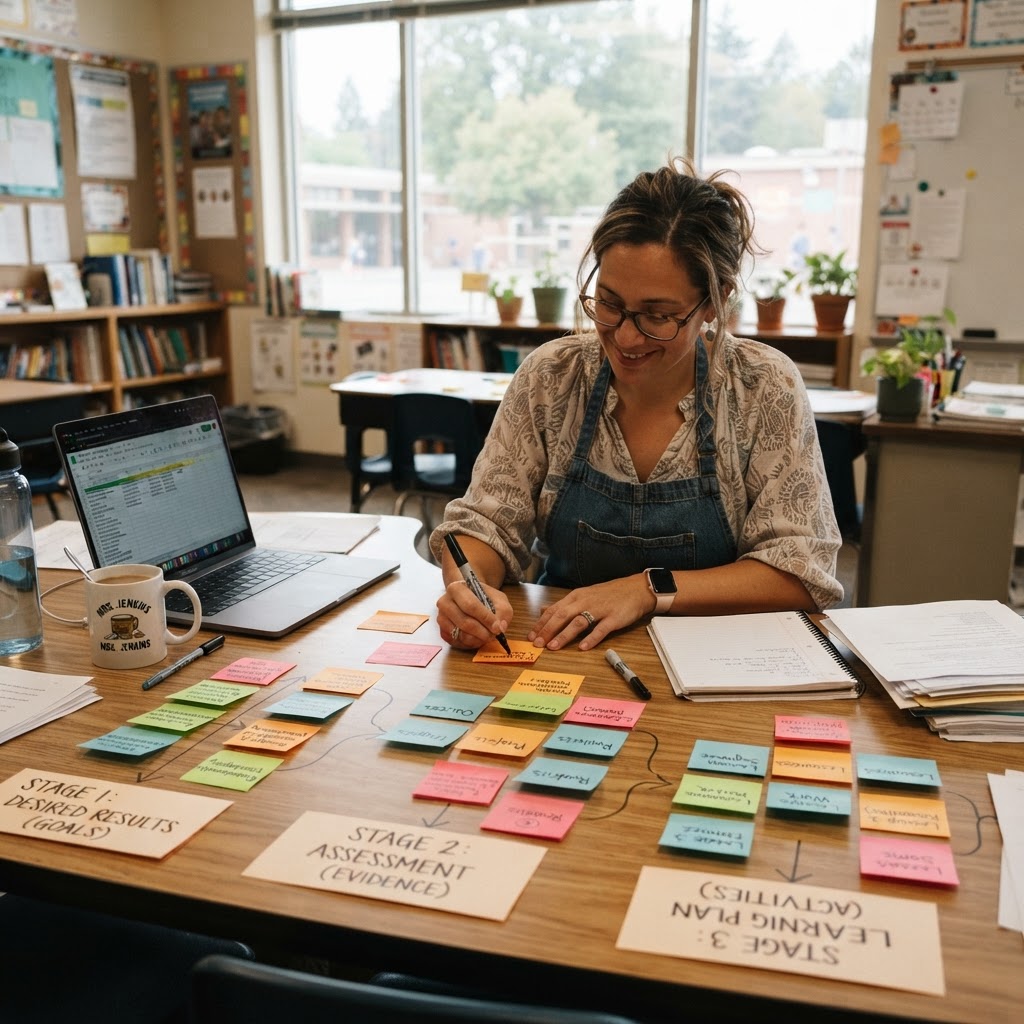
Stage 3: Plan Learning Experiences
Only now do you choose activities — and each one earns its place by serving Stage 1 or Stage 2. UbD offers a practical litmus test (the "WHERE" elements): where is the unit going, hook the students, explore and equip, rethink and rehearse, exhibit. A good check: open your unit plan and pick any activity at random. Can you say, in one sentence, what understanding it builds or what evidence it produces? If not, it is decoration.
Running a Backward Design Session
- Work in the negative space first: draft the enduring understandings as full sentences ("Students will understand that..."), then cut ruthlessly to two or three.
- Write the transfer task before the lessons: a real or realistic situation where students use the understanding in a novel context.
- Design the rubric with the task: if you cannot describe what excellent looks like, the task is not yet written.
- Then, and only then, list lessons — each one mapped to the evidence it produces.
Why It Holds Up
Backward design survives because it is really a theory of alignment: outcomes, evidence, and experiences designed to match. Two decades of curriculum research since UbD — from constructive alignment studies to the international coherence literature — keep confirming the same principle: alignment is not one quality among many; it is the quality from which the others follow. The ASCD white paper remains the best short introduction, and the framework applies identically to a single Friday lesson and a district-wide K-12 sequence.