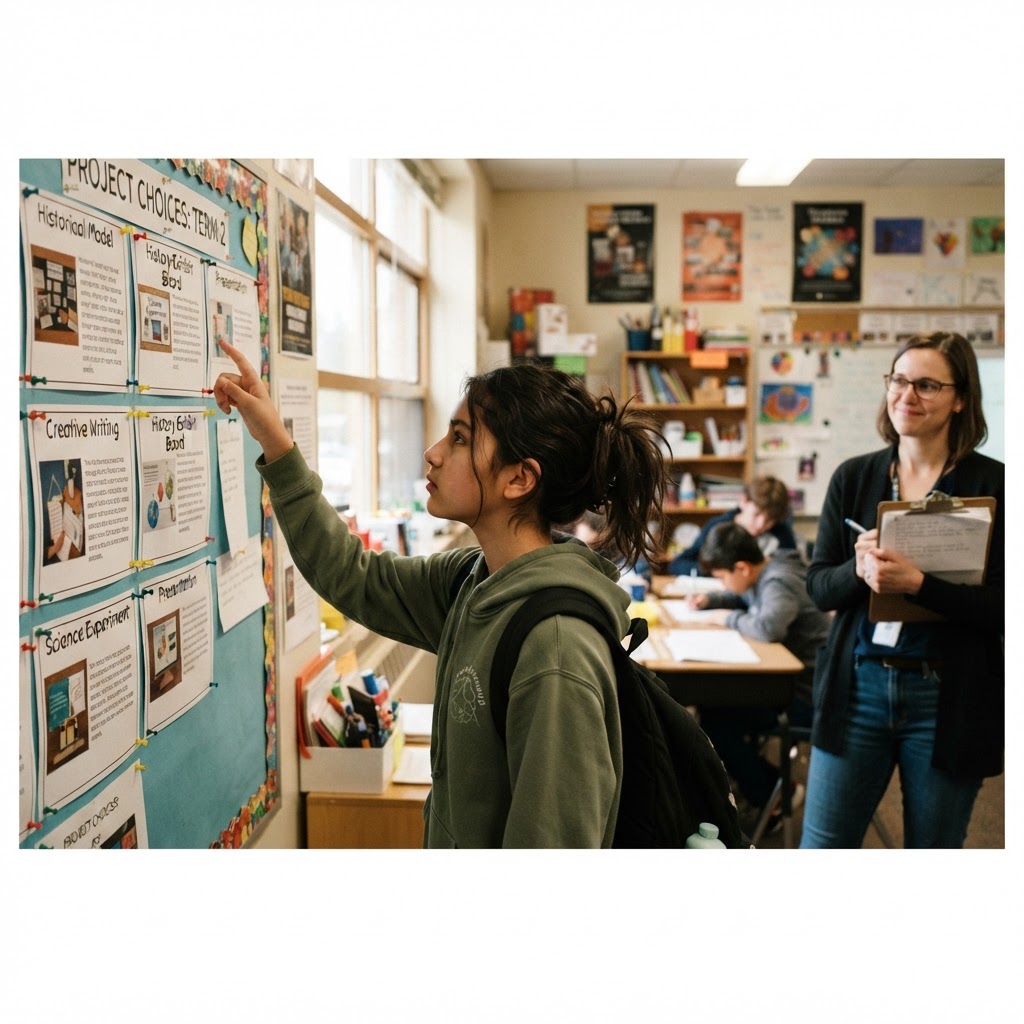
There is a version of the engagement problem that no management technique solves: students are not tired of thinking, they are tired of pretending. Work that exists only to be graded — essays no one reads, problems no one has, posters no one sees — asks for effort while quietly announcing that the effort is ceremonial. The research on authentic, project-based curriculum addresses that directly, and it is some of the strongest evidence in this entire series.
The Randomized Evidence
- Students in project-based AP courses built around authentic civic problems outscored traditional sections by 8 percentage points on credit-qualifying exams — with effects holding across demographic groups.
- The middle-school project-based science trials found an 11-point science gain plus spillover gains in math and English — students who do real intellectual work get better at school generally, not just at the tested subject.
- Across both trial programs, researchers explicitly measured engagement: treatment students reported higher engagement than controls, and engagement mediated achievement gains.
The reversal worth internalizing: in authentic units, engagement stops being the thing you engineer (points, timers, consequences) and becomes what the work produces when it has a real recipient. You cannot fake an audience — students always know.

The Design Anatomy of an Authentic Task
The trials that succeeded shared a specific anatomy — copy it, because it is copyable:
- A recipient beyond the teacher: a younger class, a community organization, a panel, a public product. The audience is the engagement engine; choose it before the content.
- Standards-first, not activity-first: the authentic question is selected because answering it requires the standards — the PBL courses that beat lecture on the AP exam were more rigorous, not less.
- A stake in the outcome: the work can succeed or fail at its stated purpose. A proposal that might actually be adopted; a model that might actually break.
- Professional artifacts and language: students produce the genre adults produce (memos, designs, datasets, briefs), which signals that the work is real in a way no rubric language can.
Starting Without a Budget or a Bus
The authentic scale is local. Fifth graders writing persuasive letters to the principal about cafeteria waste are doing authentic work; high schoolers building a budget for the actual school garden are doing authentic work. The research point is not grandeur — it is that the task's consequences live outside the gradebook. And the second research point is patience: in the trials, effects strengthened as teachers got better at the model across years. Design one authentic unit, teach it, keep the evidence, make the next one sharper. The engagement follows the authenticity, not the other way around.