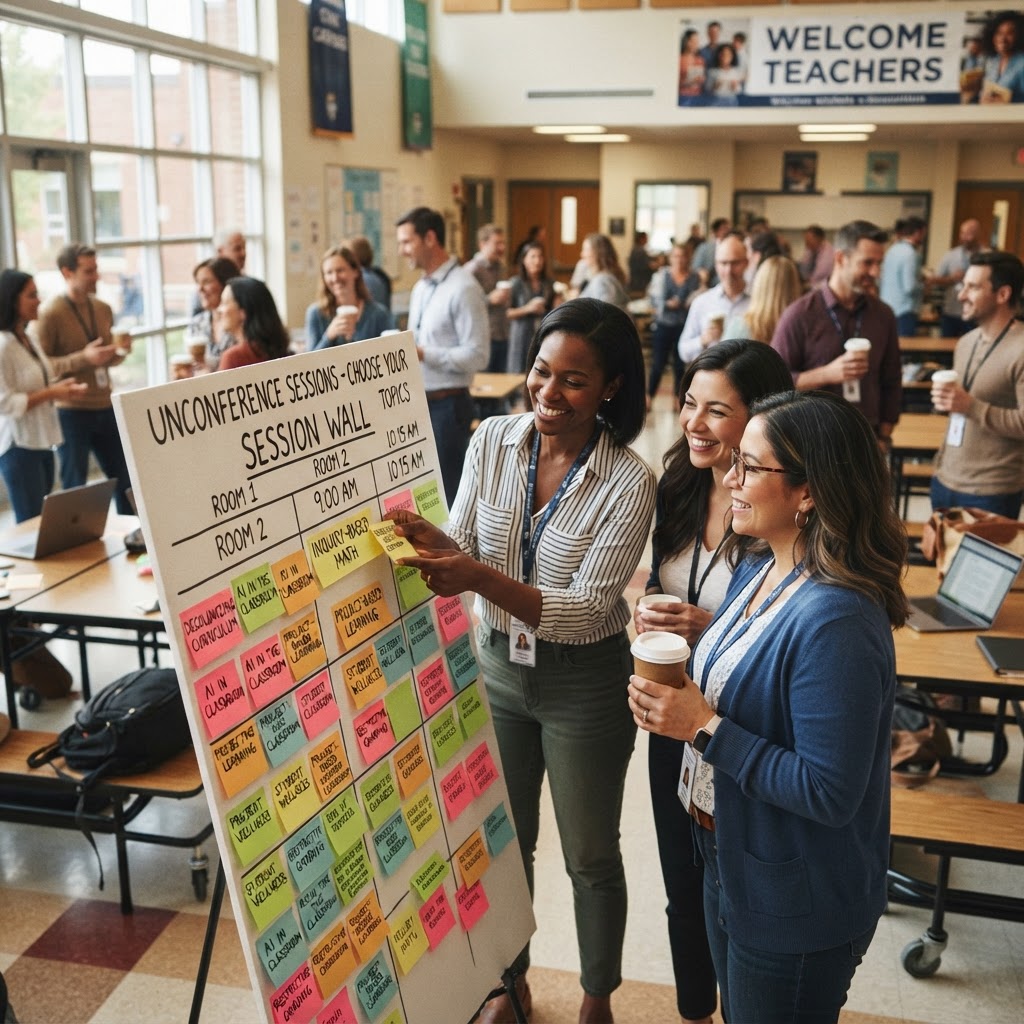
An Edcamp starts with a blank session board and a stack of sticky notes: participants propose topics that morning, and the schedule builds itself. No keynotes, no vendors, no pre-set agenda. The model spread organically from a Philadelphia bar in 2010 to events worldwide — coordinated by the Edcamp Foundation — and it caught researchers' attention precisely because it inverts every rule of traditional PD.
What the Research Says
Research on Edcamp participants (Teaching and Teacher Education) — including work by Jeffrey Carpenter, who has studied the model most closely — found that educators consistently reported the experience as valuable and directly applicable to their practice. Participants describe three features that make the difference:
- Choice: you vote with your feet; if a session does not serve you, you leave for another.
- Expertise is distributed: everyone in the room can teach and everyone can learn — no single "expert" at the front.
- Relevance: the agenda is, by construction, exactly what the people in the room want to work on.
Edcamps apply adult learning principles most PD ignores: professionals learn best when they choose what, when, and how to learn.
Try It
Edcamps are free, usually held on Saturdays, and organized by volunteers — find one near you (or start one) through the Edcamp Foundation's site. Even if you cannot attend, the design transfers: your next department meeting with a sticky-note agenda will beat the one with a pre-set PowerPoint.